
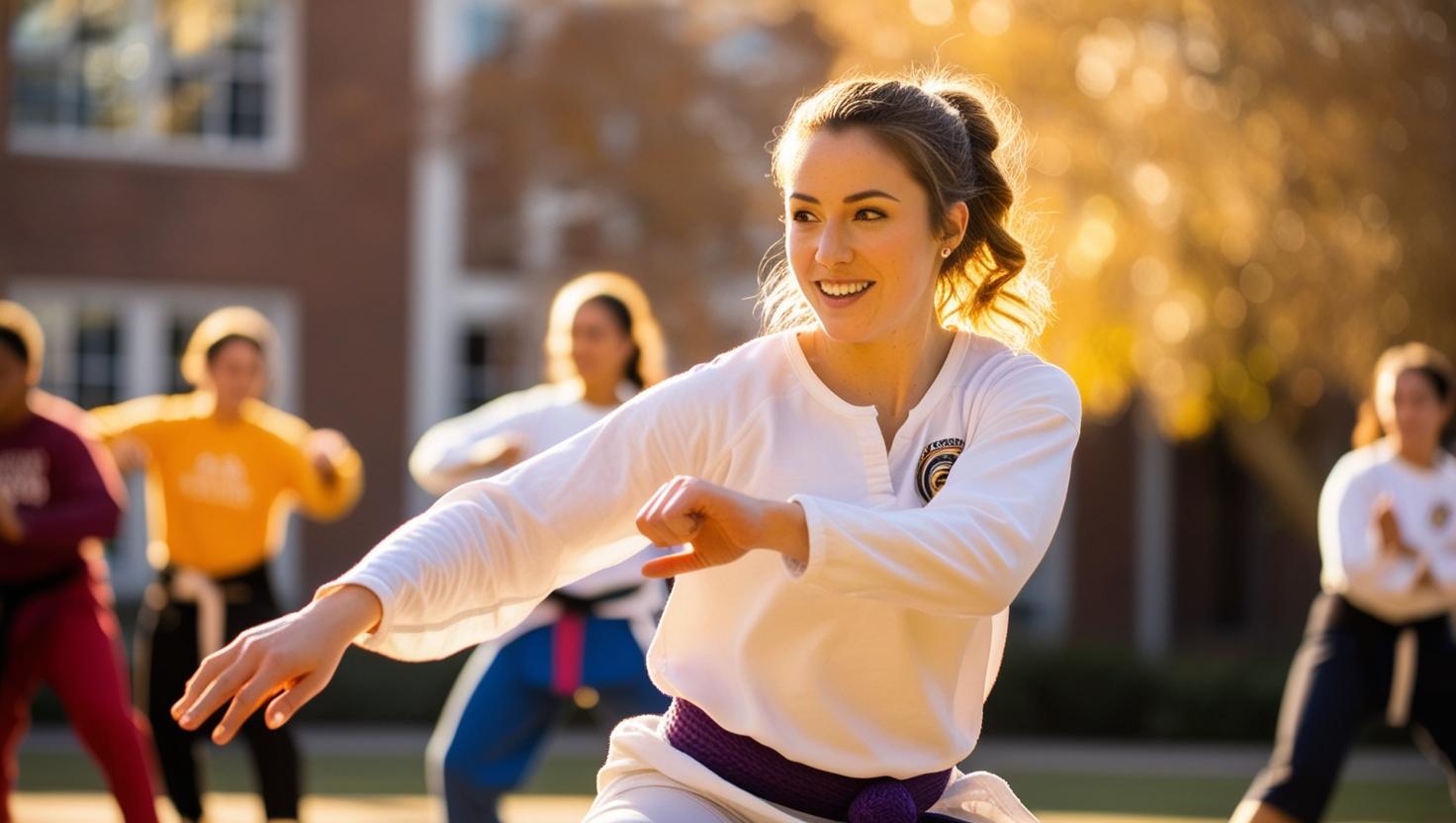
It started with a flyer taped to the student union door: “FREE CAPOEIRA CLASS THIS WEEK. NO EXPERIENCE NEEDED.” At first, it looked like another one of those fleeting campus events—free food, free fun, and then forgotten. But something about the words “Capoeira” and “no experience needed” sent a ripple through our little college bubble. By mid-morning, students were already buzzing about the free Capoeira class on campus, wondering if this mysterious blend of movement and music could really live up to the hype.
By Monday afternoon, group chats lit up. What’s Capoeira? Is it like martial arts? Is it a dance? Can we actually try it for free? Even our notoriously unimpressed dorm RA, Derek, said he was curious. Suddenly, that single flyer became a movement.
When Wednesday rolled around, the Rec Center studio buzzed with a kind of energy you don’t usually find midweek—unless it’s game night or exam panic. Inside, music with deep Afro-Brazilian beats spilled from portable speakers, and a circle had formed—students, professors, advisors, all drawn in by the rhythmic magnetism of something completely new.
Capoeira isn’t just a workout. It’s not just a performance or a fight or a dance. It’s all of that—fluid, expressive, rebellious. It was born from resistance, woven into the history of enslaved Africans in Brazil who disguised martial training as music and dance. On campus, in that one-hour session, it became a portal.
Our instructor, Davi, stepped into the circle barefoot, wearing white cotton pants and a wide smile. He told us, “In Capoeira, we don’t just move. We listen. We play. We ginga.” The word caught in our ears. Ginga. The core movement of Capoeira—a kind of swinging step, part sway, part readiness, always in motion. No stiff poses, no strict forms. Just flow.
We paired up, clumsily at first. Giggling. Unsure. But Capoeira, as we quickly learned, isn’t about perfection—it’s about participation. About rhythm. About playing with your body in space, in time with another. Even the most gym-shy students started to loosen up, swaying to the beat of the berimbau, a one-stringed bow that guided the rhythm of our movements.
What surprised most of us wasn’t just how physically demanding it was, but how fun it felt to be fully present. No phones. No scrolling. Just you, your breath, your partner, and the circle around you. People were sweating but smiling. Struggling, but somehow glowing.
And then there was the moment that defined the class. Davi invited two of us into the center of the circle—the roda. With a drumbeat behind them and cheers all around, the two students began a playful exchange of kicks, ducks, spins, and flows. They weren’t fighting; they were storytelling with movement.
Afterward, walking back through the crisp evening air, our limbs sore but spirits high, we couldn’t stop talking about it. Capoeira had flipped a switch in us. It was liberating in a way that no spin class or yoga session had ever quite captured. It wasn’t about reps or sets or calories. It was about being human—in motion, in rhythm, in community.
Later that night, my roommate added Capoeira for beginners to her YouTube search. I looked up Brazilian music playlists. Someone even ordered a foam balance trainer from Amazon to keep practicing ginga in our dorm hallway. (Pro tip: this Amazon Balance Board is the perfect way to build core strength and agility without needing a gym.)
Even our academic advisor, Dr. Liu, mentioned during a group check-in that the Capoeira session had sparked ideas about body awareness, cultural exchange, and the role of play in stress relief. “We should integrate this into our wellness programming,” she said, and we all nodded like it was already decided.
It’s rare to find something that hits every note—fitness, culture, history, mental health, and pure joy—but Capoeira does. And maybe that’s why the studio was packed again on Friday. Word spread fast. Students who had never set foot in a gym or taken a dance class were suddenly hooked. Capoeira gave us permission to move differently—and to belong.
The most stylish among us even found ways to bring the vibe into their wardrobes. Soft drawstring pants like these breathable cotton martial arts pants became overnight favorites—not just for Capoeira, but for studying, lounging, and spontaneous dance breaks in the quad.
Music lovers grabbed this portable Bluetooth speaker with deep bass to keep the rhythm going beyond the studio. Every sunset suddenly needed a Capoeira beat in the background.
By Sunday, Capoeira wasn’t just a class. It had become a kind of underground language. Someone in the library would mimic a spin or ginga in slow motion and someone else would catch the rhythm. A simple gesture, a shared smile. That’s what Capoeira does—it connects you.
So here’s the deal: if you’re reading this and you’re on the fence, let me make it easy for you. Go. Move. Try the free Capoeira class on campus. You don’t need to be flexible. You don’t need to be fit. You just need to be curious.
Capoeira isn’t about being the best in the room—it’s about showing up, letting go, and letting your body remind you how powerful play can be. And who knows? You might just find your new favorite rhythm, a new community, or at the very least, a really great reason to wear cool pants.
Next class is Friday. We’ll be there, moving to the beat, spinning and laughing and sweating in the best way. The only thing missing is you.
Disclosure: As an Amazon Associate, I earn from qualifying purchases. Thanks for supporting this blog and helping me stay caffeinated in the post-grad world.



Leave a Reply