
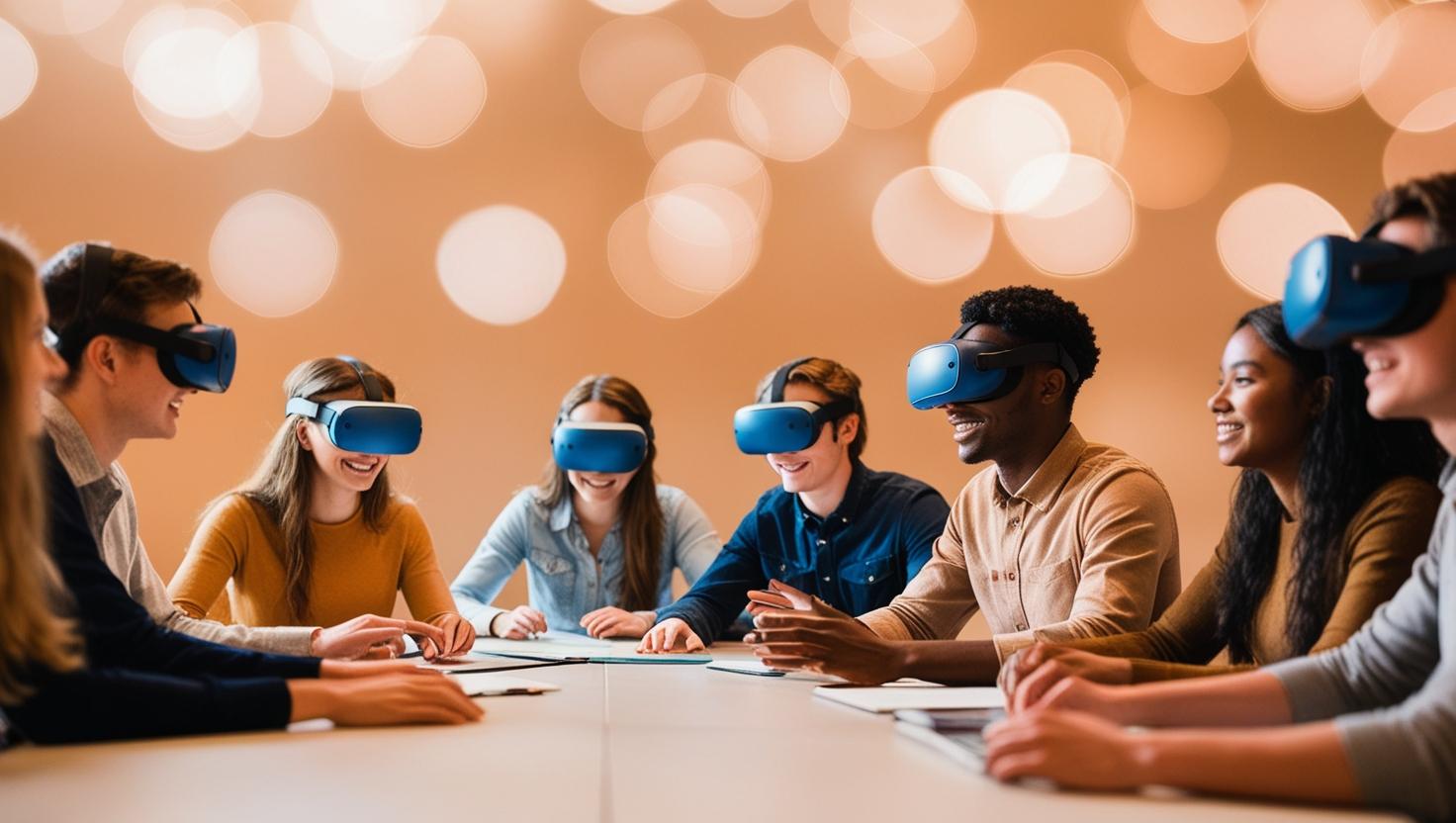
Somewhere between the half-empty lecture halls and the lingering fatigue of endless Zoom calls, a quiet revolution is unfolding—one that doesn’t just attempt to patch the cracks in college learning but dares to rebuild it entirely. It doesn’t begin with books or whiteboards but with a headset—sleek, glowing, and ready to take you anywhere. This is virtual reality in college education, and it’s not a sci-fi promise anymore—it’s the immersive new standard that’s changing everything from classrooms to dorm rooms.
To some, these VR goggles are just gaming gear. But to students like Mia—who used to dread her biology class until she found herself inside a pulsating 3D heart—they’re nothing short of transformative. She didn’t just learn the circulatory system—she walked through it. She didn’t just memorize facts—she remembered how it felt
Learning That Feels Like Magic
Before VR, learning often meant absorbing information with little connection to real-world application. But when Mia started exploring cellular structures from the inside, or when her roommate toured historical ruins in a virtual Pompeii, something shifted. They weren’t memorizing—they were experiencing.
There’s something undeniably powerful about walking through concepts instead of reading about them. The immersion taps into deeper cognitive processes: emotional engagement, spatial memory, and interactive problem-solving. Learning becomes less of a task and more of a moment—something you carry with you.
Professors are starting to notice, too.
Professors, Meet Your New Role: Experience Curator
Dr. Alvarez, a chemistry professor with no particular love for tech, hesitated when her university introduced VR simulations. But after her students began using virtual molecule builders and chemistry labs, not only did their performance improve, but their curiosity exploded. Suddenly, students were asking questions she hadn’t heard in years.
Her lectures didn’t just teach anymore—they invited. She became a guide through immersive environments where the walls of the classroom dissolved and learning unfolded all around. VR isn’t replacing educators. It’s empowering them to teach in richer, more responsive ways. It turns classrooms into experiences—and professors into storytellers, designers, and facilitators.
Education, Accessible to All
And this isn’t just for elite schools with flashy funding. Open-source platforms, grants, and affordable headsets are leveling the field. VR is making education more equitable, giving every student—no matter their zip code or budget—a seat at the front of the virtual classroom.
For students juggling jobs, disabilities, or caregiving responsibilities, virtual reality offers a flexible solution that doesn’t compromise on engagement. Instead of commuting across town, they’re commuting across time zones and centuries. One click, and they’re at the base of Mount Olympus or inside a nanotech lab.
More Connected Than Ever
Strangely enough, virtual reality—so often pegged as isolating—is where students are feeling more connected. Take Jalen, a shy engineering major who dreaded speaking in public. With VR, he practiced his final presentation in a virtual auditorium, complete with realistic feedback and even simulated nerves. When the real day came, he crushed it.
Language learners are ordering croissants in Paris cafés. Psychology majors are stepping into complex behavioral scenarios. Music students are standing on digital stages, rehearsing with virtual orchestras. The “impossible” is becoming practice. The imagined is becoming memory.
Dorms Reimagined: Your VR Haven Awaits
All of this transformation is spilling over into student living spaces. Dorms aren’t just places to crash after class anymore—they’re becoming launchpads into entire digital universes.
Late one Thursday night, Mia invited a few friends over—not for a movie night in the lounge, but for a virtual movie marathon. She handed everyone VR headsets, dimmed the lights, and queued up a sci-fi classic inside a virtual cinema, complete with mood lighting and surround sound. Her dorm had become a theater, a sanctuary, a shared experience that felt more real than anything a TV could offer.
And setting it up? Easier than anyone expected.
This simple dorm upgrade wasn’t just about fun. It became a hybrid study zone, emotional reset station, and academic game-changer. One night it was a virtual cinema, the next morning, an immersive study lab where notes came to life around her.
The Emotional Impact of Virtual Learning
Students like Mia and Jalen aren’t just retaining more—they’re feeling more. That emotional spark, so often missing from traditional education, is returning.
It’s the difference between reading about a volcano and standing at its edge. Between studying a painting and walking through the Louvre. Between listening to a foreign language and actually conversing in it.
That’s why advisors and educators are paying attention. It’s not just about grades. It’s about awakening engagement.
We’re not talking about a trend. We’re talking about a new language of learning—one that speaks in experiences, not just explanations.
Soon, virtual labs, immersive lectures, and interactive global classrooms won’t be a novelty. They’ll be expected. College applications will ask about access to VR support, and dorm shopping lists will include headsets alongside coffee makers and XL twin sheets.
Professors will continue evolving—not because they’re told to, but because their students are showing up more alive, more curious, and more prepared than ever.
In the landscape of higher education, virtual reality isn’t just a cool upgrade. It’s the reboot we’ve been waiting for.
Disclosure: As an Amazon Associate, I earn from qualifying purchases. Thanks for supporting this blog and helping me stay caffeinated in the post-grad world.



Leave a Reply